

Event
October 13, 2026 · 6 min read
Winning the Public for Nuclear: What We Bring to Taipei
On October 20, Anthropocene Institute speakers join the International Forum on Global Development of SMRs and MMRs in Taipei. Their message: the technology is ready, and public support is now the deciding factor.
Three talks in Taipei
In Taiwan’s 2025 referendum, 74 percent of voters said yes to restarting the Maanshan nuclear plant. The measure still failed, because turnout fell short of the threshold of 25 percent of the electorate.
That result frames what the Anthropocene Institute brings to Taipei on October 20. The International Forum on Global Development of SMRs and MMRs, at the Evergreen International Convention Center, is co-organized by National Tsing Hua University’s College of Nuclear Science, the Chinese Nuclear Society and the Taiwan Nuclear-grade Industry Association. Developers including X-energy, Holtec, NuCube Energy, Antares and Westinghouse are presenting their small and micro modular reactors to Taiwanese manufacturers and investors.
Three Institute speakers are on the program. Frank Ling speaks on technology and manufacturing. Taiga Cogger, who leads the Institute’s nuclear advocacy in Japan, speaks on public opinion. And Dr. Jeffrey Bohn, Director of Energy Economics, presents a thorium reactor design for the Arctic developed by ThorGatr Energy.
Public permission is the bottleneck
Reactors are licensed, financed and sited by people: voters, communities and legislators. Elections decide whether plants close or restart, siting needs communities that say yes, and investment follows stable, popular policy. Cogger’s argument is that in much of the world, the majorities already exist. The work now is turning quiet approval into active, visible support.
The surveys he presents show that shift. In the United States, ecoAmerica’s 2025 American Climate Perspectives Survey, run in partnership with the Institute, found 73 percent support for converting retired coal plants to nuclear, with nearly identical support among Republicans and Democrats. In Japan, a February 2026 poll found 51 percent support for reactor restarts, rising to 66 percent among people aged 18 to 29. In Taiwan, a 2024 survey by Radiant Energy Group, co-sponsored by the Institute, found 83 percent support for keeping existing plants and 51 percent for building new ones.
The challenge is no longer persuasion alone. It is turning quiet majorities into visible, active support.
Making the cost of closure visible
Poll numbers are abstract. In November 2024 the Institute’s data science team launched Save Maanshan, a live tracker that uses Taipower’s real-time generation data to estimate what replacing the plant with coal has cost.
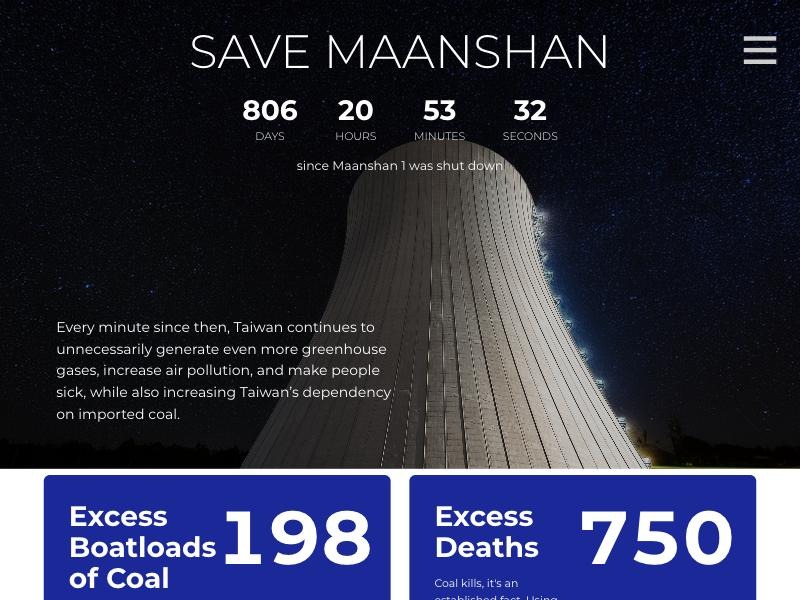
Our new Save Maanshan Report sets out the full calculation. From July 2024 to October 2026, Taiwan went without 30.28 terawatt-hours of low-carbon electricity. If coal made up the difference, that means 27.98 million tonnes of extra CO₂eq, an estimated 742 premature deaths and 196 Panamax shiploads of coal. In 2026, Taipower applied to restart the plant.
The tracker is built as a template. The same approach, applied to Belgium at Save Bel7, shows what closing three of its seven reactors has cost in gas imports, emissions and health. Any country or plant can have its own.
Changing minds where it is hardest
Japan’s relationship with nuclear energy is shaped by Fukushima and, more deeply, by Hiroshima and Nagasaki. Cogger’s approach there has four parts: site visits that make nuclear real for students, young professionals and journalists; dialogue on that history, including with Charles Oppenheimer; programs for high-school students before they choose careers; and content that documents and shares the work.
Much of that content runs through Got Nuclear, the Institute’s public-awareness project. Its live counters compare lives saved by nuclear power with coal, and its blog, written largely from Tokyo, takes on the questions people actually ask about fear, waste, AI demand and energy security, in English, French, Polish and Japanese. This year the Institute is launching WePlanet Japan, the first chapter in Asia, with co-founder Yu Fujiwara.
Young people are leading. At the International Youth Nuclear Congress 2026 in Avignon, Team Japan, including Cogger and Fujiwara, placed third in the Innovation4Nuclear competition with NUVITA, a plan to turn cleared metal from decommissioned plants into traceable products, from emergency kits to public benches. About 92 percent of a large reactor’s decommissioning waste is not radioactive.
A reactor designed for the Arctic
Dr. Bohn presents a different kind of answer, prepared with M. Kinoshita of ThorGatr Energy: a liquid-fuel thorium reactor designed for remote, sparsely populated polar regions such as Alaska, where warming is melting sea ice and disrupting wildlife and local livelihoods.
The design aims to supply local electricity cheaply without refuelling, and to reject heat underground without melting the ground ice. ThorGatr describes a fuel cycle that runs on thorium, a design kept far from weapons development, and a system that could burn transuranic waste accumulated in the United States, Europe and Japan. The company launched this year in San Francisco and works with the U.S. Department of Energy, Oak Ridge National Laboratory and the University of California.
The reactors in Taipei are ready to be built. Whether they are built depends on the people who will live next to them.
The full report
Save Maanshan Report
Peter Gichuki · Anthropocene Institute · 7 pages
This piece draws on the presentations “Changing Minds: No nuclear renaissance without the public” by Taiga Cogger and “Standing Up to a Warming Arctic” by M. Kinoshita (ThorGatr Energy) and Dr. Jeffrey Bohn (Anthropocene Institute), prepared for the International Forum on Global Development of SMRs and MMRs, Taipei, October 20, 2026.
About the Author
The Anthropocene Institute funds and publishes research on nuclear energy, solid-state fusion, grid electrification and ocean carbon, and convenes the entrepreneurs, investors and policymakers building clean firm power.