
Interview
June 26, 2026 · 5 min read
Shortcuts to Climate Repair: Frank Ling at London Climate Action Week 2026
Anthropocene Institute Chief Scientist Frank Ling spoke with We Don’t Have Time about phytoplankton carbon removal, nuclear energy, and why solid-state fusion deserves serious study.

By Frank Ling and We Don’t Have Time
Video: We Don’t Have Time
A portfolio of shortcuts
At London Climate Action Week 2026, We Don’t Have Time sat down with Dr. Frank Hiroshi Ling, Chief Scientist at the Anthropocene Institute, at the Sustainable Ventures venue in County Hall to talk about carbon removal, nuclear energy and the frontier of fusion research.
Ling described the Institute as a California-based family office and philanthropic organization working to change the conversation on clean energy. Its focus is on breakthrough technologies that could act as shortcuts through the climate and energy emergency. That means a whole portfolio rather than a single bet: renewables, nuclear, novel fusion approaches and, most recently, biological carbon removal.
Borrowing a process from the ocean
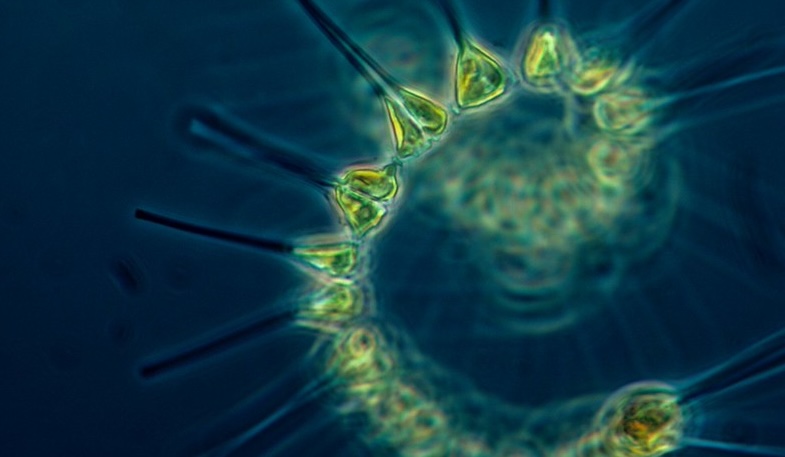
Asked why carbon capture is worth another look when many industrial projects have proved costly or disappointing, Ling drew a distinction. The approach the Institute is studying is biological, not an industrial capture plant. In parts of the South Pacific, iron released from ocean vents appears to trigger blooms of phytoplankton, which take up carbon as they grow. The question is whether that natural process can be mimicked safely and scaled toward the gigaton level the climate problem requires.
Ocean iron fertilization has been proposed before. Ling said some earlier attempts were not carried out rigorously and involved actors the scientific community did not regard as credible. The Institute is instead working step by step with the government of Tonga and scientists at USC to test whether the method is safe and scalable. The working estimate he cited is that one gram of iron catalyst could lead to roughly 13,000 to 14,000 grams of CO₂ captured. Whether it works is still an open question, he said, and the studies are designed to answer it in a way other scientists will trust.
“Whether it’ll work or not we don’t know yet.”
More on this work is on the Phytoplankton Carbon page.
Why nuclear belongs in the mix
On nuclear energy’s recent momentum, Ling pointed to the energy crisis and the rapid growth of electricity demand from data centers. Nuclear has often been seen as too dangerous or too expensive, but the Institute’s view is that a resilient energy system needs a diversity of sources. He said the Institute’s own research finds nuclear costs competitive with renewables, depending on the country.
He also addressed safety. Public perception is shaped by Fukushima, Three Mile Island and Chernobyl, he said, but the statistics on health and environmental impacts show nuclear to be one of the safest and most scalable sources of clean energy. He added that historically, nuclear waste has not caused people to be poisoned or killed. The interviewer noted that skepticism has come from governments and researchers as well as the media, and that the current growth suggests many people are reevaluating.
Read more about the Institute’s work on atomic energy.
The fusion frontier
No energy technology is free of economic, technical or safety risk, Ling said, and concerns about uranium are valid. Fusion has drawn a great deal of attention and funding, and within it there are different classes: some where the science is proven but the engineering is hard, and others where the science is still speculative but could be revolutionary if confirmed.
Solid-state fusion falls into the second group. It explores whether fusion-like processes can be enabled through quantum effects that are not yet fully understood. Ling was clear that nobody knows yet whether it will work, but argued it deserves investigation because of what it could mean for the world’s energy system.
He explained the difference between the two nuclear processes. In both, matter is converted to energy following Einstein’s E=mc². Fission splits heavy atoms. Fusion merges the nuclei of light atoms by overcoming the electrostatic repulsion between them, which he compared to squeezing the positive ends of two magnets together until they join. The sun does this at around 100 million degrees under enormous pressure, and replicating those conditions on Earth is extremely difficult and expensive. That is why the Institute supports research into other routes to the same result.
Hot fusion’s media attention is good for the field, he said, because it brings in resources. The harder question is how quickly any of it can be commercialized. In the 1990s, fusion was said to be 30 years away, and 30 years later people still say the same.
How quickly costs can fall
The interview closed on how fast an energy technology can change once it starts to scale. Ling used solar as the example, now one of the largest sources of renewable energy. He said that since solar PV was first commercialized in the 1950s, its cost has fallen by about four orders of magnitude. Today, most of the cost of putting panels on a roof is in installation and permitting rather than the panels themselves.
That history is the case for exploring many options at once. As Ling put it, we don’t know in advance which ones will work.
This piece draws on an interview with Dr. Frank Hiroshi Ling, Chief Scientist at the Anthropocene Institute, recorded by We Don’t Have Time at London Climate Action Week 2026. Watch the full conversation: youtu.be/jp-y4KJr1ng
About the Authors
Frank Hiroshi Ling is Chief Scientist at the Anthropocene Institute. He is also a guest lecturer at the Tokyo Institute of Technology and Ibaraki University, a reviewer for the EarthShot Prize, and producer and host of the science podcast “Groks Science”. We Don’t Have Time is a climate media platform that recorded this interview at London Climate Action Week 2026.
Chief Scientist, Anthropocene Institute

Climate media platform