

Molten Salt Reactor (MSR)
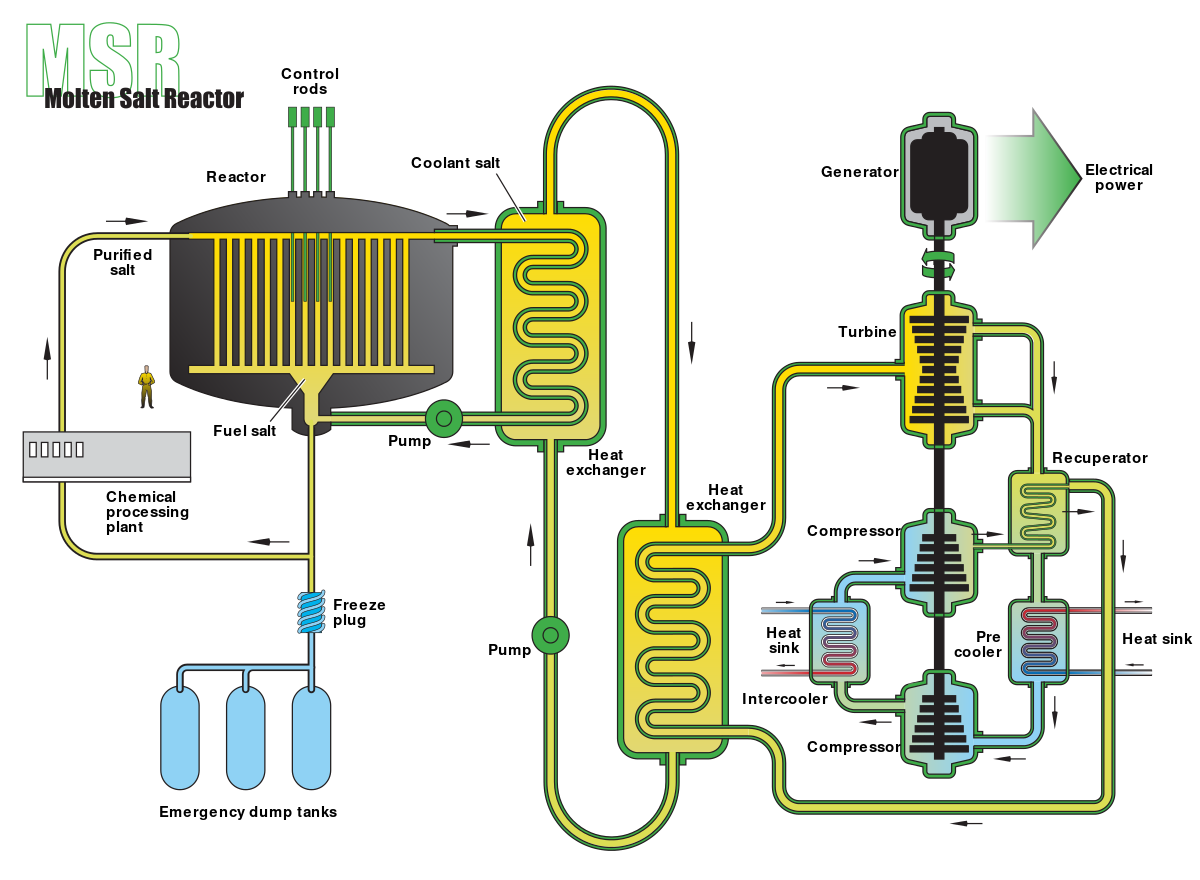
Like light water reactors, MSRs use nuclear fission to generate heat. Instead of water for coolant, they use liquid fluoride or chloride salt mixtures.
45%
electrical conversion efficiency with a closed-cycle turbine, against 33% for LWRs
1965–69
Oak Ridge ran the Molten Salt Reactor Experiment at 7.4 MW thermal
What is molten salt reactor (MSR) technology?
Molten salt reactors (MSRs) are one of several next generation (Gen IV) nuclear reactor designs under development today. Like light water reactors (LWRs), MSRs use nuclear fission to generate heat. However, instead of using water for coolant, MSRs use liquid fluoride or chloride salt mixtures, a.k.a. salts.
MSR designs have a number of potential advantages in safety, efficiency, waste management over LWRs. Interest in commercializing MSR has grown since 2002 when the Generation IV International Forum (GIF) selected MSR as one of six most promising fourth generation nuclear reactor designs for international R&D collaboration.
What types of MSR reactors are there?
Type 1
Dissolved fuel
Coolant and the fuel are the same fluid. The nuclear fuel, which is either uranium, plutonium, or thorium is dissolved in the molten salt.
Type 2
Solid fuel (FHR)
The fluoride salt-cooled high-temperature reactor. Fuel is made of solid particles less than 1 mm wide suspended in molten fluoride coolant, and remains solid as fission proceeds.
There are two primary types of MSR: dissolved and solid fuel.
Applications, proof and efficiency
The heat from MSRs and other advanced nuclear reactors is amenable for a diverse range of applications including process heat, chemical processing, desalination and hydrogen production. Because MSRs are smaller than LWRs, the military has envisioned their use for marine propulsion.
The MSR is one of thirteen prototype nuclear reactors that was conceived and tested at. Oak Ridge National Laboratory (ORNL). At the time, a task force under the Atomic Energy Commission determined that “the highest probability of achieving technical feasibility.” The laboratory successfully ran its Molten Salt Reactor Experiment (MSRE) between 1965 and 1969. This reactor produced 7.4 MW of thermal power
MSRs have higher thermal efficiencies than LWRs because they operate at higher temperatures (700C to 800C) than conventional reactors (300C). MSRs with a closed-cycle turbine can reach 45% electrical power conversion efficiency. In contrast, LWRs, which use traditional steam turbines, only achieves 33% efficiency.
| Measure | MSR | Light water reactor |
|---|---|---|
| Operating temperature | 700C to 800C | 300C |
| Power conversion efficiency | 45% with a closed-cycle turbine | 33% with traditional steam turbines |
| Coolant pressure | Atmospheric; no containment dome needed | Pressurized |
| Fuel form | Liquid, or solid particles in liquid coolant | Solid fuel rods |
Can MSRs melt down or explode?
Unlike the nuclear accidents at Fukushima Daiichi, Chernobyl, and Three Mile Island, MSRs fundamentally cannot meltdown because the fuel is already in liquid form. MSR employs passive safety by the nature of the coolant. When temperature rises, the salt coolant expands, slowing down the nuclear fission reaction.
Furthermore, if the reactor overheats, a plug melts at the bottom of the reactor and the liquid fuel is immediately evacuated into a catch basin below the reactor where the salt expands and becomes a solid as it cools to below 500C. In the event that the reactor vessel, pump, or pipe is ruptured, the salt simply solidifies and the nuclear fuel cannot contaminate the environment.
Because MSRs operate at atmospheric pressure, there is no risk of the reactor exploding. Unlike LWRs, the coolant is not pressurized and therefore a containment dome is not needed.
Negative feedback
Rising temperature expands the salt, which slows the fission reaction on its own.
Freeze plug
Overheating melts a plug and drains the fuel into a catch basin, where it solidifies below 500C.
Atmospheric pressure
Nothing to drive an explosion, and no containment dome required.
How much waste does MSR produce?
MSR generates less waste than conventional nuclear plants because these reactors do not use fuel rods that are used in LWRs. In addition, the reprocessing of highly radioactive fuel salts is not needed with FHR because it is efficient at burning transuranic elements. FHR can be configured to use the spent fuel from conventional reactors. In France and Russia, researchers are developing MSR that breed in the uranium or thoriums fuel cycles.
What are the technical challenges to commercialize MSR?
While MSRs have numerous design advantages in safety, waste management, cost, and efficiency over LWRs, the concept requires further development and validation.
Materials
Corrosion
Molten salts have a corrosive effect on structural materials in the vessel and heat exchangers. Development is focused on tuning the coolant and on alloys and ceramics resilient to radiation and chemical attack.
Containment
Tritium control
Tritium is the only isotope that could escape during normal operation. Stripping technology from irradiated salt still needs adequate demonstration, and double-walled heat exchangers are being tested.
Instrumentation
Controls in hot, corrosive service
Flow meters and control systems must tolerate high temperatures and corrosive materials while meeting passive and active safety requirements.
Fuel cycle and licensing
Refueling, waste, approval
Each reactor type needs its own fuel cycle worked out, and regulators must build a safety and licensing approach suited to MSR’s unique features. No startup has yet designed a complete MSR plant for regulator approval.
“The International Atomic Energy Agency (IAEA)… consists of 17 member countries for MSR development … including the US, Canada, China, Russia, France, India, Norway, and Denmark.”
Timeline and who is developing MSR
MSR and other Generation IV nuclear designs are intended for commercialization after 2030. The US Nuclear Regulatory Commission (NRC) expects at least two of the advanced nuclear reactor designs, including MSR, to reach technical maturity by the early 2030s.
In 2016, the International Atomic Energy Agency (IAEA) established a collaborative platform consisting of 17 member countries for MSR development. The US, Canada, China, Russia, France, India, Norway, and Denmark have active programs to commercialize MSR.
Among them, China is making the most aggressive effort to realize MSR for commercial production. The Shanghai Institute of Applied Physics (SINAP), which has a workforce of 500 researchers, is developing both MSR and FHR for demonstration in 2025 and deployment in the 2030s.
In the US, there are at least nine publicly and privately funded MSR efforts underway in universities and companies. The Department of Energy (DOE) is supporting MSR development through the GAIN MSR Technical Working Group that consists of six companies, as well as ORNL and Argonne National Lab. The DOE is also funding the development of FHR through a tri-university consortium that consists of Massachusetts Institute of Technology (MIT), University of California at Berkeley, and University of Wisconsin.
From experiment to deployment
1965–69
Oak Ridge runs the MSRE at 7.4 MW thermal, then shuts it down
2002
GIF names MSR one of six most promising Gen IV designs
2016
IAEA establishes a 17-country collaborative platform
2030s
NRC expects at least two advanced designs, MSR included, to reach technical maturity
Early work was not stopped on technical grounds: in spite of the early success in demonstrating MSR, the MSRE was shut down due to a combination of limited budget and the Atomic Energy Commission’s preference in pursuing the alternative sodium-cooled fast breeder reactor design.