
New Energy Sources
A variety of facilities generates electricity, including fossil fuel-burning power plants, hydroelectric dams, nuclear power plants, and a variety of renewable energy sources that include solar, wind, geothermal, and biomass.
4 trillion
kilowatt-hours of electricity generated in the United States in 2015
67%
of that generation came from coal, natural gas and petroleum
What are the sources of power? What kind of power plants are there?
A variety of facilities generates electricity, including fossil fuel-burning power plants, hydroelectric dams, nuclear power plants, and a variety of renewable energy sources that include solar, wind, geothermal, and biomass. The location of these electricity generators – and their distance from end users – varies widely.
In 2015, the United States generated about 4 trillion kilowatt-hours of electricity. About 67% of the electricity generated was from fossil fuels (coal, natural gas, and petroleum). 99 nuclear power plants provided about 20% of the power mix. Hydropower and renewables account for 6% and 7% of the mix, respectively.
How is power produced and managed?
Coal, gas, oil, and nuclear power plants all produce electricity by driving steam turbine through thermal power generation. While electricity generation can be varied on advanced gas turbines, coal and nuclear power plants can only be turned on to full power output.
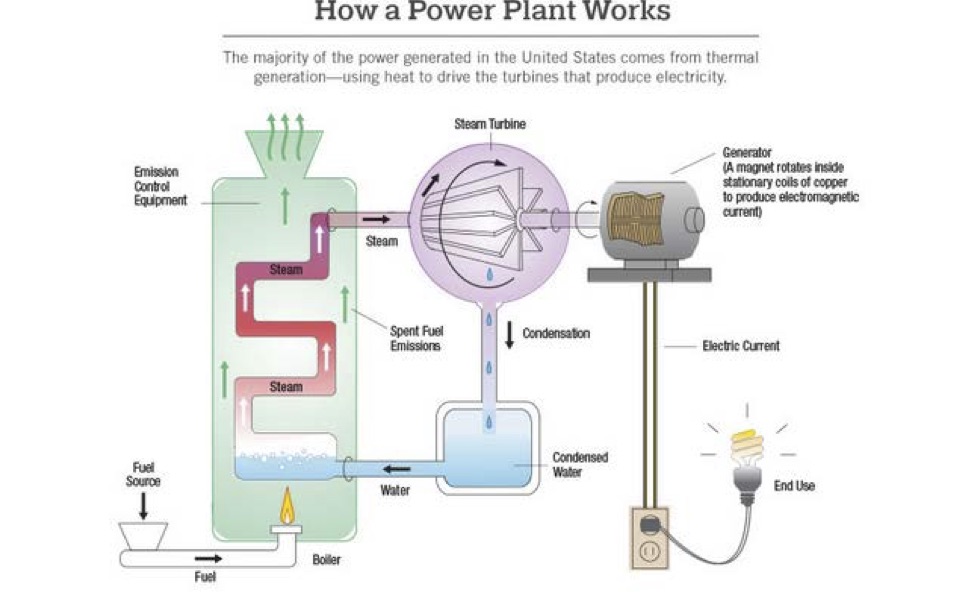
Hydropower uses the potential energy in a water reservoir to spin turbines that then produce electricity for the grid. Similarly, wind turbines take the currents of the wind to create electricity. Solar photovoltaic (PV) systems convert sunlight into electricity.
Heat to steam
Coal, gas, oil, nuclear
Fuel or fission heats water; the steam drives a turbine coupled to a generator.
Falling water
Hydropower
Potential energy stored in a reservoir spins turbines on its way downhill.
Moving air
Wind
Turbine blades convert the currents of the wind into rotational energy.
No turbine
Solar photovoltaic
PV systems convert sunlight into electricity directly, with no moving parts.
How is power delivered to your home?
Power is delivered to your home via the distribution network of high-power transmission lines. At the “last mile” a sub-station in your neighborhood steps-down the electricity to a voltage that you can use in your home. These networks start at the transformers and end with homes, schools, and businesses. Distribution is regulated on the state level by PUCs and PSCs, who set the retail rates for electricity in each state.
Plant to plug
Generation
The plant produces power and a step-up transformer raises its voltage
Transmission
High-power lines carry electricity away from the generator
Last mile
A neighborhood sub-station steps the voltage down to a usable level
End use
Homes, schools and businesses, at retail rates set by state PUCs and PSCs
The delivery system has its own primer: see The Electrical Grid for interconnections, ownership and markets.
How do renewables factor into power generation?
Power generation from renewable sources, particularly solar cells and wind turbines are already becoming major sources of power. They are expected to meet future energy demand but also displace existing generation from fossil fuels and nuclear power.