
Event · COP31, Antalya
November 10, 2026 · 6 min read
Energy Security Is Food Security: Notes from COP31
Fertilizer, fresh water and cold storage are what let agriculture scale. All three need clean power that runs around the clock.

Chief Scientist, Anthropocene Institute
Food runs on energy
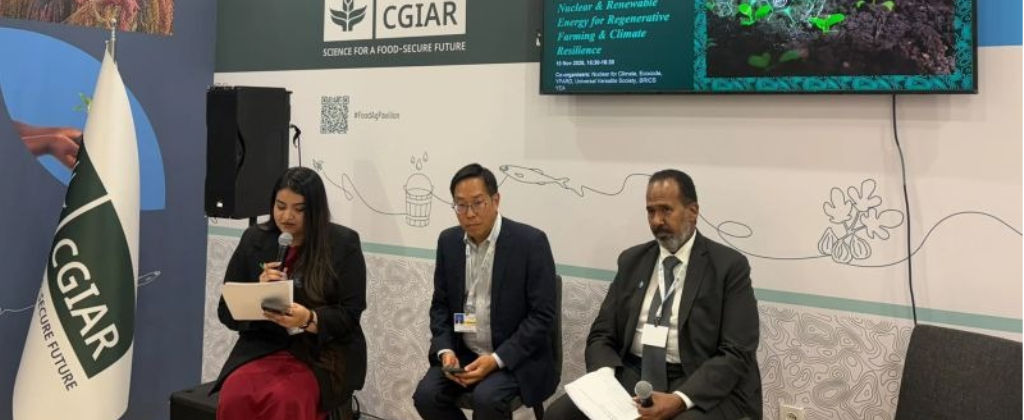
On November 10, I gave a keynote at the Food and Agriculture Pavilion, run by CGIAR and the Food and Agriculture Organization of the United Nations (FAO) at COP31 in Antalya, Türkiye. The session was called Energy-Smart Agrifood Systems: Nuclear & Renewable Energy for Regenerative Farming & Climate Resilience, and it was co-organized by groups including Nuclear for Climate, YPARD, the Universal Versatile Society and the BRICS Youth Energy Agency. I am grateful to the FAO and Nuclear for Climate for making it possible.
Our moderator, Diksha Sharma, a nuclear safety engineer and UK events lead for Nuclear for Climate, opened with the premise for the hour: “Food systems run on energy.” Energy pumps irrigation water, makes fertilizer, keeps cold chains cold and desalinates water. The question she put to us was how nuclear and renewables can work together for farmers, especially in climate-vulnerable regions.
I spoke after Khalid Al Othman, President of Imar Engineering Consultants and a member of the UNCCD Business4Land Champions’ Council. He put the link in one sentence: “Food has become an energy issue, and energy has become a food security issue.” This is what I added.
Monoculture is a risk in energy too
Early in my climate career I worked on climate adaptation, and one principle from that work has stayed with me: diversity is a good thing. Monoculture is not good for agriculture as my colleague Guido Nunez likes to say, and it is not good for energy systems either. I see diversity in energy systems as the key to resilience, and to adapting as environmental conditions change.
At the Anthropocene Institute, our founder Carl Page likes to emphasize that our goal is to deliver energy that is ten times cheaper than fossil fuels. At that price, many of the problems we are witnessing, from agriculture to health to pollution, become solvable.
For food security, I see energy mattering in three places.
Fertilizer
The first is the energy embedded in what farmers put on their fields. Ammonia is the starting point for all mineral nitrogen fertilizers, and making it today relies heavily on fossil fuels.
The crisis in the Strait of Hormuz this year showed what that dependence costs. The FAO says 20 to 30 percent of global fertilizer exports pass through the strait. According to the World Trade Organization, urea prices more than doubled, from around $400 a tonne to over $850 in April, before easing by June. The WTO counts 18 economies as especially exposed, among them Kenya, Malawi, Mozambique and Uganda, and the FAO has warned of lower yields and tighter food supplies into 2027. In developing countries, a fertilizer price shock has become a food security emergency.
India is one country acting on the connection. The week before COP31, I was at the Asia Pacific Nuclear Energy conference in Macau, where my colleague Gayatri Karnik presented India’s nuclear growth plans. India’s Nuclear Energy Mission targets 100 gigawatts of nuclear capacity by 2047, and its reactor program includes a high-temperature design built to produce hydrogen, the ingredient ammonia plants now get from fossil fuels. That matters for a country that sourced almost two-thirds of its nitrogen fertilizer imports from the Gulf, according to the WTO.
So we do see that energy security is also food security.
Water
The second is water. Agriculture already accounts for more than 70 percent of global freshwater withdrawals. Any additional supply will have to come from desalination, which takes a great deal of energy.
Nuclear plants have done this before. Kazakhstan’s BN-350 reactor at Aktau turned Caspian seawater into about 80,000 cubic meters of fresh water a day from 1973 to 1999, supplying the city and its industry. Reactors in India and Japan supplied heat for desalination in 2025. We know this technology is scalable.
Cold storage
The third is the cold chain. The FAO estimates that 13.2 percent of food is lost after harvest and before it reaches a store. It rots, or it does not survive distribution. Clean, stable energy is what keeps food from expiring on the way to market.
Solar energy is very good at driving pumps, for example, but it does not always work when the sun is not there. Cold storage, desalination and fertilizer production need clean firm energy. As part of the energy mix, nuclear is one of the choices for supplying it, working in harmony with solar and wind.
Fertilizer, fresh water and cold storage are key to a successful and scalable agricultural system, and all three require clean firm power.
Nuclear science on the farm
Nuclear science also helps agriculture in ways that have nothing to do with electricity. The FAO and the International Atomic Energy Agency have run a joint centre for nuclear techniques in food and agriculture since 1964. One of its tools, mutation breeding, uses radiation to speed up natural variation in seeds and has produced more than 3,200 officially released crop varieties in over 70 countries.
My key takeaway is that these types of partnerships should be supported and scaled, and kept low-cost and accessible to every country.
What I heard from the rest of the session
Mr. Al Othman’s keynote carried a caution that applies to every technology I mentioned. “Technology alone does not create resilience,” he said. A solar-powered irrigation system is not sustainable if it speeds up groundwater depletion, and no innovation helps if farmers cannot afford it. I agree with his call for collaboration across food science, energy engineering and infrastructure. I would add AI and robotics, which are still emerging and could drastically improve the efficiency of labor in agriculture.
Panelists from Colorado State University, the Northeast Asia Youth Climate Council, the BRICS Youth Energy Agency and YPARD covered the economics of irrigation, solar projects that pair power with farming in Mongolia, biogas from farm waste, and farms that produce energy as well as consume it. Audience questions ranged from biodiversity to affordable technology for smallholder farmers. On hydrogen for fertilizer, Arsenii Kirgizov-Barskii of the BRICS Youth Energy Agency named nuclear as one way to scale up low-carbon supply.
The session ended with a summary in verse. Rapper and science communicator Baba Brinkman performed a song he had written during the hour, and I got a line: “Atomic desalinization, baby, talk to Frank. That’s how you turn on the tap.”
I am happy to take him up on that.
This article is adapted from my keynote at “Energy-Smart Agrifood Systems: Nuclear & Renewable Energy for Regenerative Farming & Climate Resilience,” Food and Agriculture Pavilion, COP31, Antalya, November 10, 2026. Watch the full session; my remarks begin at about 17:40.
About the Author
Frank Hiroshi Ling is Chief Scientist at the Anthropocene Institute. He is also a guest lecturer at the Tokyo Institute of Technology and Ibaraki University, a reviewer for the EarthShot Prize, and producer and host of the science podcast “Groks Science”.
Chief Scientist, Anthropocene Institute