
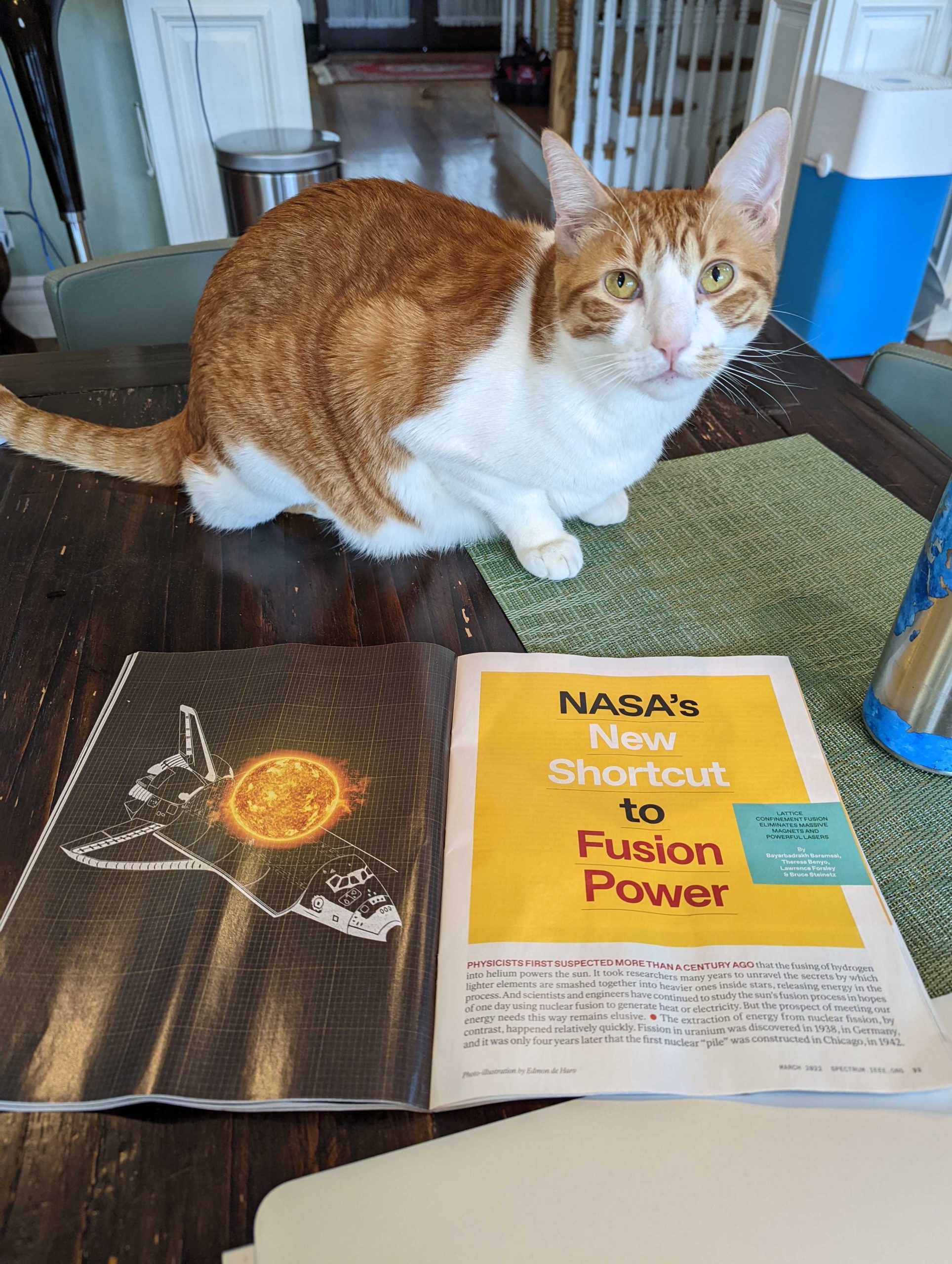
The Anthropocene Institute has been partnering with Lawrence Forsley, the deputy principal investigator for NASA’s lattice confinement fusion project, based at NASA Glenn Research Center. He and other researchers’ work have now been highlighted in IEEE Spectrum, “NASA’s New Shortcut to Fusion Power, Lattice confinement fusion eliminates massive magnets and powerful lasers.”
How lattice confinement fusion works
In the article, Larry and his coauthors Bayarbadrakh Baramsai, Theresa Benyo, and Bruce Steinetz explain how NASA has traditionally powered deep-space travel, including photovoltaic cells, fuel cells, and radioisotope thermoelectric generators (RTGs). Now NASA is turning its attention to lattice confinement fusion (LCF), a fusion in which hydrogen is bound in a metal lattice, encouraging positively charged nuclei to fuse. These researchers are not alone in their endeavors. Researchers at Lawrence Berkeley National Laboratory, with funding from Google Research, achieved favorable results with a similar electron-screened fusion setup.
The authors and other scientists and engineers at NASA Glenn Research Center are investigating whether this approach can provide enough power to operate robotic probes on the surface of Mars, for instance. The good news: LCF would eliminate the need for fissile materials such as enriched uranium. The process would also be less expensive, smaller, and safer than other ways of harnessing nuclear energy.
Uses on Earth
Most promising: LCF could also find uses here on Earth as it matures. Imagine LCF powering small power plants for individual buildings, which would reduce fossil-fuel dependency and increase grid resiliency. These researchers are making significant strides in creating a new way of generating clean nuclear energy, both for space missions and for people on Earth.
Congratulations to Larry Forsley and others making breakthroughs on the LCF front. It’s time these new developments get the support they deserve.
About the Author
The Anthropocene Institute funds and publishes research on nuclear energy, solid-state fusion, grid electrification and ocean carbon, and convenes the entrepreneurs, investors and policymakers building clean firm power.