
Research
November 12, 2026 · 6 min read
Belgium’s Reactor Closures: Costs, Supply Changes and Scenarios to 2045
A new Anthropocene Institute report examines what the 2022–2025 closures have meant for costs, health and the electricity system, and how outcomes to 2045 differ with and without nuclear.

Research: Núñez-Mujica, Pineda, Amuza, Gichuki
Nuclear power supplied around half of Belgium’s electricity for most of the period since 1985. Between September 2022 and November 2025, five of the country’s seven reactors were permanently shut down, removing 3,866 megawatts of net capacity. A new research report by Anthropocene Institute data scientists Guido Núñez-Mujica, Jesús Pineda, Melania Amuza and Peter Gichuki, Restarting Nuclear Power: An Economic and System Assessment for Belgium, examines the consequences of those closures.
The report addresses two questions. First, what have the closures meant for fuel and carbon costs, health, emissions and the electricity system? Second, how do projected outcomes to 2045 differ with and without continued nuclear operation? To answer them, the report combines Belgian and European generation data, gas and carbon market prices, published health-impact factors, grid-operator adequacy studies and a scenario model. This article summarizes the main findings and the limitations the report identifies.
Costs not reflected in wholesale prices
Wholesale-price modelling for Belgium indicates a modest price effect from additional nuclear capacity. Aurora Energy Research estimates that extending three further reactors would lower the 2035 baseload price by about 4%, with Belgian prices remaining strongly influenced by neighbouring markets.
The report examines several cost channels that wholesale-price analysis does not capture:
- fuel expenditure and exposure to gas-price volatility
- carbon-allowance costs under the EU Emissions Trading System
- health costs associated with air pollution from fossil generation
- grid services such as inertia, which are procured separately or not priced at all
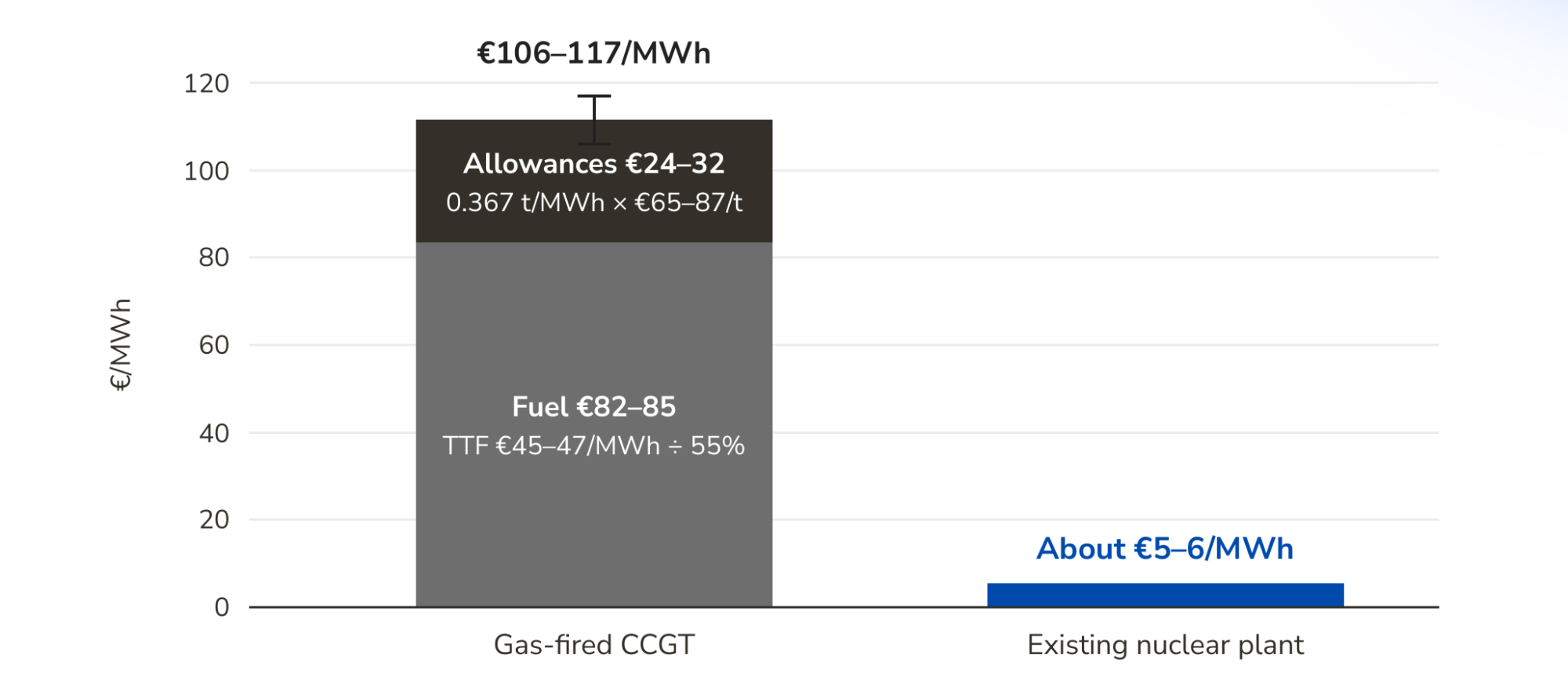
The comparison begins with variable operating costs. At early-2025 prices, a combined-cycle gas turbine (CCGT) incurs about €82–85 per megawatt-hour in fuel and €24–32 in carbon allowances, a total of roughly €106–117. An existing nuclear plant’s fuel cost is about €5–6 per megawatt-hour, with no allowance cost. Both figures exclude capital, fixed operating, waste and decommissioning costs.
The report then estimates the cost of replacing the closed reactors’ annual output, about 28.8 terawatt-hours at an 85% load factor, entirely with gas-fired generation. On that assumption, the gross annual costs are:
- Fuel: about €2.4 billion (sensitivity range €1.4–3.1 billion)
- Carbon allowances: €0.7–0.9 billion
- External health costs: €0.4–0.7 billion
That totals roughly €3.5–4.0 billion a year at early-2025 prices. At November 2026 gas prices, the fuel component alone would be about €4.5 billion. These are gross figures. They do not net off the capital and operating costs of restarting reactors or any associated liabilities. Because they measure avoided costs rather than price effects, the report cautions that they should not be added to wholesale-price estimates.
Empirical studies of earlier closures report effects through similar channels. Jarvis, Deschenes and Jha (2022) estimate the social cost of Germany’s post-2011 nuclear shutdowns at €3–8 billion a year, mostly from air-pollution mortality associated with replacement fossil generation. Davis and Hausman (2016) find that the 2012 closure of California’s San Onofre plant raised generation costs by about $350 million over the following twelve months.
Observed changes in supply, 2021–2025
The report compares the gas-replacement assumption with observed data. Between 2021 and 2025:
- Nuclear’s share of domestic generation fell from 50.6% to 33.5%.
- Domestic gas-fired generation also declined, from about 22.6 TWh to 15.0 TWh.
- Wind and solar output increased by about 6 TWh.
- Belgium’s net trade position moved from 7.9 TWh of net exports to 13.4 TWh of net imports, mainly from France and the Netherlands.
The carbon intensity of domestic generation rose from 127 to 151 grams of CO2 per kilowatt-hour between 2024 and 2025.
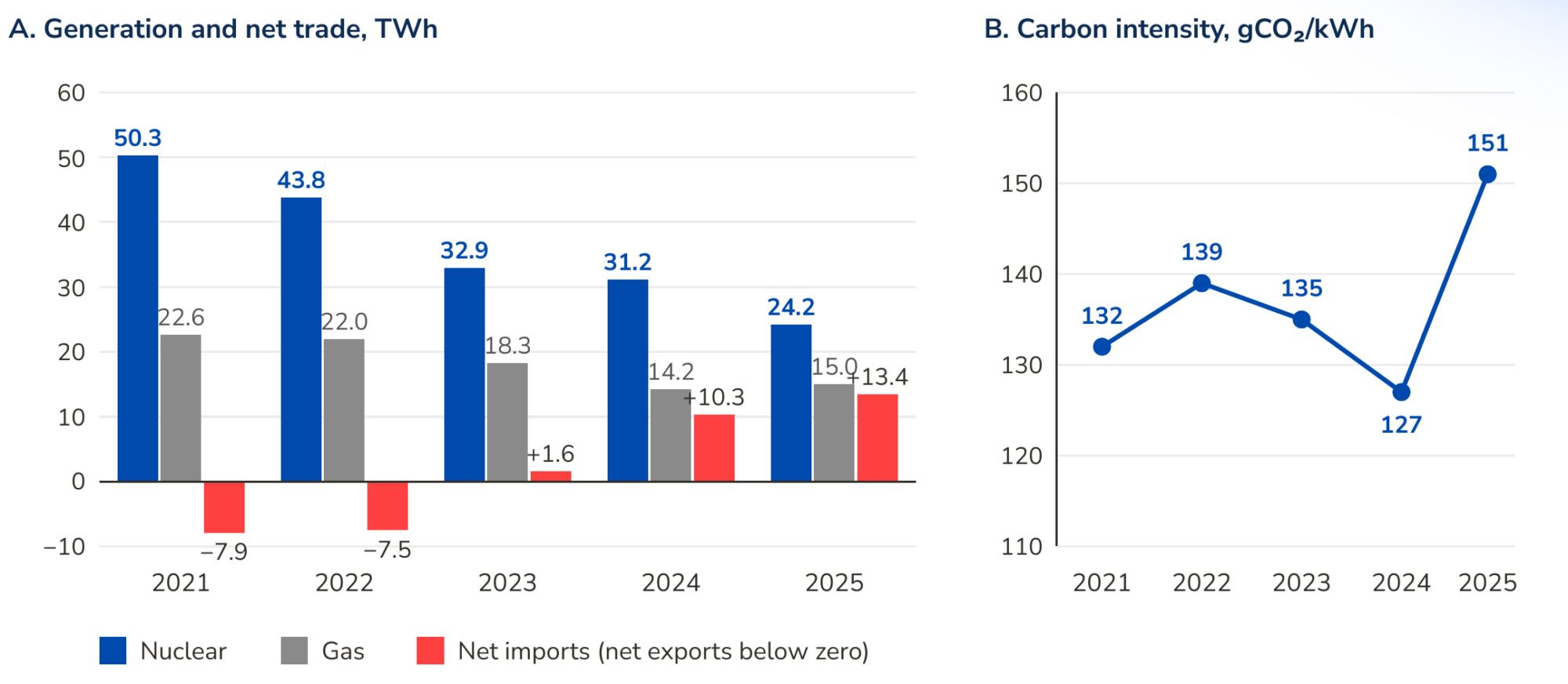
Because lost nuclear output was replaced mainly by imports and renewable growth rather than domestic gas, the report treats the gas-replacement estimates as an upper bound on effects within Belgium. The system-wide effect depends on the marginal generation in neighbouring countries during the hours Belgium imported. Belgian statistics do not record that, so its magnitude remains uncertain.
Scenarios to 2045
The report projects several supply scenarios to 2045. Electricity demand is assumed to roughly double between 2025 and 2050, from about 80 TWh to 150–160 TWh, driven by electrification of transport, heating and industry. That assumption is consistent with expectations from Elia, Belgium’s grid operator. Wind, solar and battery capacity grow in line with stated national objectives, and an optimistic case assumes 50% more wind and solar generation by 2045 and faster battery deployment. The principal scenarios are run in pairs: one with the nuclear fleet closing by 2035, and one with all seven reactors operating.
The scenarios are not least-cost optimisations or forecasts. Imports, demand response and new firm low-carbon capacity are not represented, so gas is the only residual source of supply. Lost nuclear output is assumed to be replaced by gas one-for-one.
Under these assumptions, the report finds the following for 2026–2045:
- Gas: gas-fired generation remains in the supply mix in every scenario. Continued nuclear operation reduces cumulative gas generation by 43–52% relative to otherwise identical scenarios.
- Emissions: continued operation is associated with about 320 million fewer tonnes of CO2-equivalent, corresponding to €21–29 billion in allowance costs at €65–90 per tonne.
- Health: continued operation is associated with about 1,700 fewer premature deaths attributable to gas-fired generation (central estimate; roughly 400–7,000 across the published 95% interval of the health factor), and about 18,000 fewer serious illnesses.
- Storage: the additional battery capacity required to avoid gas-fired generation is 31–43% lower, depending on the scenario.
Limitations
The report identifies several principal sources of uncertainty:
- Replacement assumption. The avoided-cost estimates and scenarios assume one-for-one replacement of nuclear output by gas. Observed data show that imports and renewable growth accounted for most of the replacement.
- Gas and carbon prices. Fuel-cost results scale with the benchmark TTF gas price, which ranged from about €32 to over €100 per megawatt-hour between November 2025 and November 2026. Allowance-cost results scale with the EU carbon price.
- Health factors. Mortality estimates use European-average factors published by Markandya and Wilkinson in 2007. They do not reflect Belgian plant characteristics, population exposure or subsequent tightening of emission standards.
- Restart feasibility and cost. Radiant Energy Group, whose assessment argues for restart, estimates €2.95–4.1 billion to return the five closed units to operation, excluding compliance with updated regulatory requirements. Regulatory statements to date indicate that the oldest units do not meet current requirements, and two units have hydrogen-flake indications in their reactor pressure vessels. The no-exit scenarios follow Radiant’s restart timelines, which the regulator has not assessed.
- Ownership and financing. The report documents existing ownership, contract and financing arrangements for Belgium’s reactors. The terms of any future transaction, including valuation and the allocation of liabilities, are not public and are not modelled.
The report concludes that its results indicate “the direction and approximate scale” of the quantities involved. These are not estimates of the net cost or benefit of any specific transaction or restart programme. The full report also covers grid adequacy, inertia and transmission, evidence from Sweden and Finland, and indicative battery-storage costs.
This article summarizes Restarting Nuclear Power: An Economic and System Assessment for Belgium (Anthropocene Institute, November 2026) by Guido Núñez-Mujica, Jesús Pineda, Melania Amuza and Peter Gichuki. Read the full report: anthropoceneinstitute.com/research/belgium-restarting-nuclear
About the Author
The Anthropocene Institute funds and publishes research on nuclear energy, solid-state fusion, grid electrification and ocean carbon, and convenes the entrepreneurs, investors and policymakers building clean firm power.