
Research
October 13, 2026 · 6 min read
Switzerland Has Already Tested Life Without a Nuclear Plant
When Leibstadt and Gösgen went offline for months, almost all of the missing power came from abroad. Before voters decide on new reactors, the outages are worth a closer look.

By Anthropocene Institute
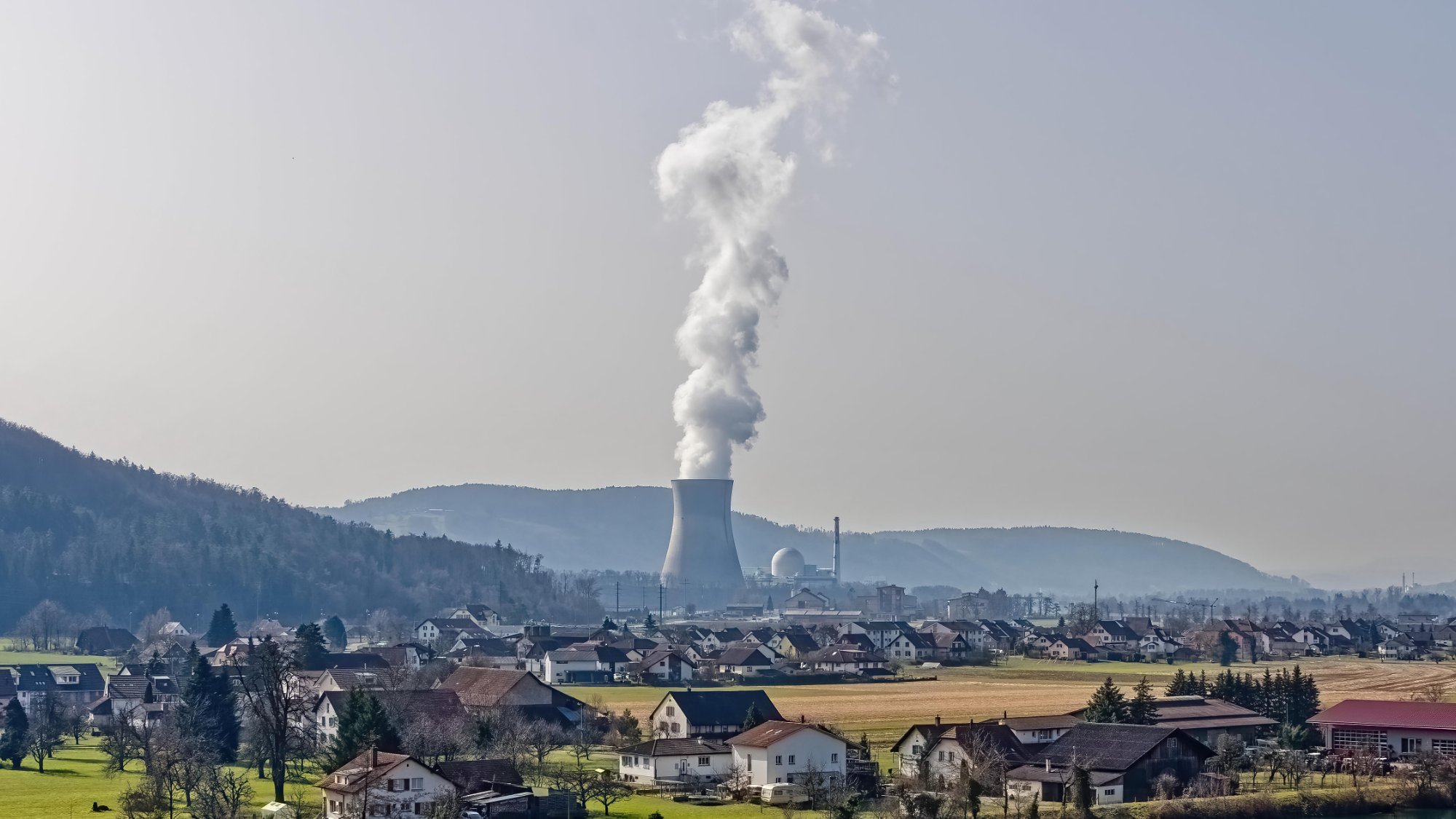
Photo Credit: Roland Zumbühl

The question is winter
In the first week of November 2025, Switzerland imported 194 gigawatt-hours of electricity. That is normal. After a summer of exports from full reservoirs and rooftop solar, the balance tips every autumn, and the country leans on its neighbours until spring.
That seasonal gap sits underneath the vote Swiss citizens are likely to cast in early 2027. On June 19, 2026, Parliament lifted the ban on new nuclear power plants that had stood since 2017. A coalition of anti-nuclear groups launched a referendum against the change. Their central message is that Switzerland can meet its needs with solar, wind and hydropower, and that a lost reactor could be absorbed at home.
That second claim can be tested. Twice in recent years, a large Swiss reactor went offline for months of scheduled maintenance: Leibstadt in 2021 and Gösgen in 2025. A new report by WePlanet DACH and the Anthropocene Institute uses those outages, and five years of hourly grid data, to see where the missing power actually came from.
Where the missing power came from
The analysis, drawing on Swissgrid and Energy-Charts data from 2021 to 2025, controls for demand, weather, run-of-river output, solar, wind and the time of day and year. The result is clear: for every gigawatt of Swiss nuclear capacity that goes offline, the country’s cross-border balance shifts by about 853 megawatts. Imports rise or exports fall by almost the full amount.
When a Swiss reactor stops, the replacement mostly arrives across the border, not from a domestic fix.
Covering each outage took between 4.6 and 4.8 terawatt-hours of extra generation in Germany, France, Italy and Austria. In both episodes, most of that generation was fossil. The report’s displacement model puts the added CO₂ at roughly 2.2 million tonnes for Leibstadt and 1.8 million tonnes for Gösgen, though the authors are careful to call those figures model-dependent.
Why the reservoirs didn’t fill the gap
Switzerland’s storage dams are often described as the domestic alternative to nuclear. The outage data show what they did instead. During each outage, operators released about 2.1 terawatt-hours of reservoir water earlier than they otherwise would have. In the following months, almost exactly that amount was held back again. Over the full period, hydropower covered a residual of a few gigawatt-hours.
A reservoir holds a fixed volume of water. Using it now means not having it later. With nuclear running around the clock, that water can be saved for the hours when it is worth the most. Without nuclear, it becomes a short-term patch, and the country’s flexibility is spent before the coldest weeks arrive.
The summer of 2026 added another reason for caution. After the driest spring since records began in 1864, Swiss reservoirs fell to about 46 percent of capacity, their lowest level in 20 years, and many run-of-river plants ran at reduced output. Hydropower remains the backbone of the Swiss system. It is also exposed to the same climate change the country is trying to address.
What the No campaign gets right, and what it leaves out
Opponents raise real questions, and the report takes seven of them in turn. A new reactor would need public support: BAK Economics estimates that market revenue would cover only about 55 percent of its cost. Russia’s state nuclear company has controlled a large share of global uranium enrichment. And a June 2026 study by ETH Zurich and the Paul Scherrer Institute finds a net-zero Switzerland without new nuclear technically feasible.
The fuller picture changes each conclusion. Per megawatt-hour, the support a new reactor needs is lower than what alpine solar receives under the federal Solarexpress program. Western enrichment capacity has been expanding since 2022, and Axpo now sources fuel from Canada and Kazakhstan. The same ETH/PSI study still has Switzerland importing between 5.4 and 12.4 terawatt-hours each winter in 2050, about what it imports today.
A vote on keeping the option open
The useful question is not whether nuclear or renewables should win. It is how Switzerland keeps its winter supply secure, affordable and low-carbon when no one knows what power will cost in 2050, how much clean electricity neighbours will have to sell, or how reliably the reservoirs will fill.
The report’s stress test gives a sense of scale. In 2025, thermal plants supplied about 3.6 terawatt-hours of Swiss electricity. One 1.2-gigawatt reactor would generate about 9.5 terawatt-hours a year. Running alongside existing hydropower, it could cover the four peak hours of every day, with the surplus reducing imports or helping neighbours retire their own fossil plants.
A Yes vote does not build a reactor. It allows one to be built if it proves sensible. For voters weighing the choice, a fair question to put to either campaign is simple: when a large plant is offline in January, where does the power come from?
Switzerland has run that test twice, and the answer was across the border.
The full report
Why Switzerland Says Yes to New Nuclear Power Plants
Guido Núñez-Mujica & Niels-Arne Münch · WePlanet DACH and the Anthropocene Institute · 31 pages
This piece draws on Why Switzerland Says Yes to New Nuclear Power Plants: Seven claims by the opponents, fact-checked, by Guido Núñez-Mujica (Anthropocene Institute) and Niels-Arne Münch (WePlanet DACH). The outage analysis is the Anthropocene Institute’s own.
About the Author
The Anthropocene Institute funds and publishes research on nuclear energy, solid-state fusion, grid electrification and ocean carbon, and convenes the entrepreneurs, investors and policymakers building clean firm power.